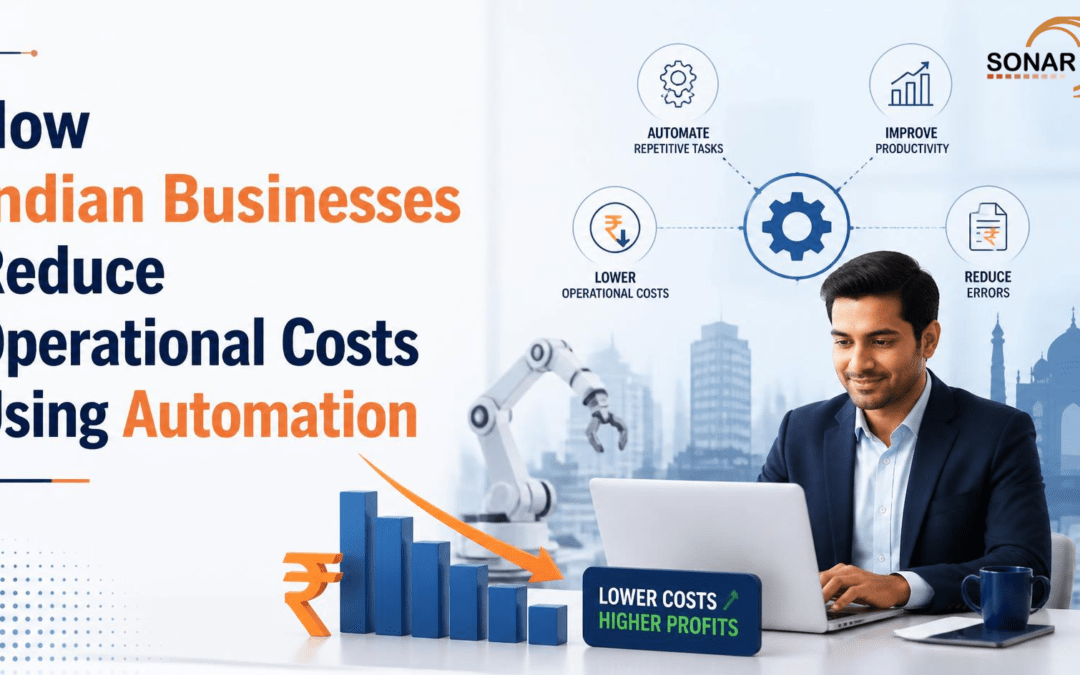
Rising labour costs, increasing operational compulsion and escalating customer expectations have combined to increase the pressure on businesses across India. From factories and warehouses to logistics firms, retail outlets, and corporate offices; cost management while ensuring productivity has emerged as one of the key challenges businesses have been facing.
Most organizations look to spend less on the cost side to avoid hiring or investing in serving their clients. But these are all short-term solutions and usually come at the cost of service standards, not to mention employee morale.
The more durable answer is the automation of business.
To work more efficiently and manage all operational functions, you need to cut costs without jeopardizing productivity and customer satisfaction.
What causes operational costs to rise frequently & How Automation ENABLES the Indian Businesses to be more efficient & profitable.
Why Operational Costs Keep Increasing
The operational expenses don’t typically increase due to a single problem. Rather they accumulate due to a number of inefficiencies, which get layered on with time.
A few of the most prominent cost drivers are:
- Manual administrative work
- Payroll errors
- Employee overtime
- Inventory losses
- Production delays
- Inefficient workforce scheduling
- Duplicate data entry
- Poor communication between departments
- Equipment downtime
- Compliance penalties
Each of these issues may sound small on their own, but together they can add up to be a large hit on profitability.
Pain Point 1: Time-consuming Manual Processes
The Challenge
Older generation practices like spreadsheets, paperwork and manual approvals are still used in businesses for day to day operations.
Workers are disengaged for hours every week by:
- Recording attendance
- Preparing payroll data
- Updating inventory
- Creating reports
- Processing invoices
- Approving leave requests
Such things take up your precious time and do not directly bring business.
The Solution
Business Automation Software helps automate repetitive tasks by:
- Automatically capturing attendance
- Generating reports instantly
- Sending approval notifications
- Updating records in real time
- Reducing paperwork
Less time spent on admin work and more on productive activities.
Pain Point 2: Payroll Errors Resulting in Higher Costs
The Challenge
Manual payroll processing frequently results in:
- Incorrect salary calculations
- Overtime mistakes
- Attendance discrepancies
- Delayed salary processing
- Employee disputes
This leads HR teams to lose extra hours in correcting mistakes.
The Solution
Automated workforce management system consolidates attendance, leave time, overtime and payroll all in one place, improving accuracy and reducing manual effort.
Pain Point 3: Under-Appearing Personnel
The Challenge
Improper Scheduling of Business Processes typically faces:
- Overstaffing
- Understaffing
- Excessive overtime
- Low employee productivity
- Idle labour hours
All this means that output is gained at a higher labour cost.
The Solution
Workforce Management Software supports their managers in creating optimized schedules, effective resource allocation, and ease of monitoring the utilization of the workforce in real time.
Pain Point 4: Inventory Losses and Stock Errors
The Challenge
Inventory inaccuracies can result in:
- Overstocking
- Stock shortages
- Lost sales
- Wasted warehouse space
- Emergency purchases
These issues are a result of regular manual inventory tracking.
The Solution
With the help of barcode systems and RFID technology, automation creates real-time visibility into your stock and helps to reduce errors, moving towards effective control over your inventory.
Pain Point 5: Slow Approval Processes
The Challenge
Whether it’s purchase approvals, expense approvals, leave requests or vendor payments, most processes involving approvals pass through a handful of emails or paper forms.
This causes:
- Delayed projects
- Slower purchasing
- Missed deadlines
- Increased administrative workload
The Solution
Automated workflows ensure that approvals are routed to the right managers; reminders are sent, and all records are maintained, making decision-making faster and delays fewer.
Pain Point 6: Equipment Downtime Impacts Productivity
The Challenge
Equipment in manufacturing and warehouse businesses runs the operation.
Unexpected breakdowns can lead to:
- Production delays
- Missed delivery deadlines
- Emergency repair costs
- Idle employees
The Solution
These automation systems can monitor equipment performance, schedule preventive maintenance, and alert their teams before failure occurs so that downtime is reduced – something expensive to businesses.
Pain Point 7: Duplicate Work Across Departments
The Challenge
We already have separate records for the same data maintained by different teams.
For example:
- Sales updates customer details.
- Finance enters the same information.
- Operations create another record.
This duplication wastes precious time and introduces the possibility of inconsistency.
The Solution
Integrated business process automation platforms integrate departments and allow data to be entered once and shared across the organization.
Pain Point 8: No real-time business insight
The Challenge
Business owners often face difficulties when attempting to answer questions such as:
- Which department is the most productive?
- Where are operational costs increasing?
- Which projects are behind schedule?
- How efficiently are employees being utilized?
Decisions are rarely made without data, and anyone who relies on inaccurate data to make decisions understands that often such decisions either get delayed or need assumptions.
The Solution
Automation brings real-time dashboards and analytics, helping managers detect inefficiencies at an early stage and make well-informed decisions to drive down costs.
How Automation Reduces Operational Costs
1. Reduces Administrative Work
Routine processes like attendance, payroll preparation, reporting, and approvals are automated, which allow employees to work and focus on high value activities.
2. Improves Employee Productivity
Automation helps you move away from repetitive tasks and allows employees to focus more on customer care, tackling challenges, and enabling business scaling.
3. Minimizes Human Errors
Automated systems reduce mistakes in payroll, inventory, invoicing, and reporting, lowering the costs associated with rework and corrections.
4. Optimizes Resource Utilization
Managers have more visibility into the availability of workforce, equipment usage, and where inventories stand so they can be allocated most efficiently.
5. Improves Decision-Making
Of course, actionable insights supported through real-time dashboards help in making faster and more informed business decisions.
6. Scale with Business Growth without Commensurate Cost Increases
Automation allows businesses to easily cover more ground as they grow, with minimal additional administration staff or operational overhead.
Areas Where Automation Delivers the Greatest Savings
Workforce Management
Automates:
- Attendance
- Shift scheduling
- Leave management
- Overtime tracking
- Payroll integration
Outcome: Lowered capital loss associated with salary payments, increased worker productivity.
Inventory Management
Automates:
- Stock updates
- Barcode scanning
- RFID tracking
- Reorder alerts
Result: Decrease in inventory shrinkage and better stock precision.
Finance and Accounting
Automates:
- Invoice processing
- Expense approvals
- Payment reminders
- Financial reporting
Result: Improved financial processes and fewer mistakes.
Customer Relationship Management
Automates:
- Lead capture
- Follow-up reminders
- Customer communication
- Sales reporting
Result: Customer experience improved and sales productivity increased.
Document Management
Automates:
- File storage
- Approval workflows
- Document retrieval
- Version control
Result: Reduced paperwork, faster collaboration.
Industries Benefiting from Business Automation
Automation, as the name suggests, is a process where an individual uses smart technology to eliminate repetitive tasks across many industries.
- Manufacturing
- Warehousing
- Logistics
- Transportation
- Retail
- Healthcare
- Hospitality
- Construction
- IT Services
- Education
- Distribution
- Professional Services
Companies that rely on repetitive workflows and multiple departments, regardless of the industry, can automate processes.
How to Start Your Automation Journey
Take stock of your operations today, before automating:
- Which tasks consume the most employee time?
- Where do errors occur most frequently?
- Which processes rely heavily on manual work?
- What causes delays in daily operations?
- Which departments experience communication gaps?
After identifying these, you want to pick on automation projects that can bring immediate benefit ranging from operational efficiency to quantifiable cost savings.
Choosing the Right Business Automation Software
Look for a solution that offers:
- Workforce management
- Inventory management
- Workflow automation
- ERP integration
- CRM integration
- Cloud accessibility
- Mobile support
- Real-time reporting
- Scalable architecture
- Strong security features
Select software that integrates with your existing systems helps maximize efficiency while accommodating future business growth.
Conclusion
Operational cost reduction is not about making employees do more with less — it is asking them to remove unnecessary work from their day.
The current business automation facilitates businesses in India to streamline their processes, enhance workforce efficacy, minimize errors and gain better control over operations. So be it attendance automation, inventory tracking, taking approvals or payroll processing or reporting- the upshot is an organization that works smarter and has lesser operational costs.
As competition gets tougher as well as the expectation of customers continues to change, firms embracing automation shall be better placed with regards to becoming profitable, scaling fast and reacting quickly when the market demand changes.
If your organization is still relying on manual processes, now is the time to assess which functions should be automated first.
Frequently Asked Questions
1. What is business automation?
Business automation uses software and technology to automate repetitive tasks and workflows, reducing manual effort and improving operational efficiency.
2. How does automation reduce operational costs?
Automation reduces costs by minimizing manual work, improving employee productivity, reducing errors, optimizing resource utilization, and accelerating business processes.
3. Which industries benefit most from business automation?
Manufacturing, logistics, warehousing, retail, healthcare, hospitality, construction, professional services, and many other industries can benefit from automation.
4. Is business automation suitable for small and medium businesses?
Yes. Small and medium-sized businesses can use automation to improve efficiency, reduce administrative work, and support growth without significantly increasing operational costs.
5. Can business automation integrate with existing business software?
Most modern business automation platforms integrate with ERP systems, CRM software, HRMS, accounting applications, inventory management systems, and payroll solutions, allowing businesses to create a connected and efficient digital ecosystem.