
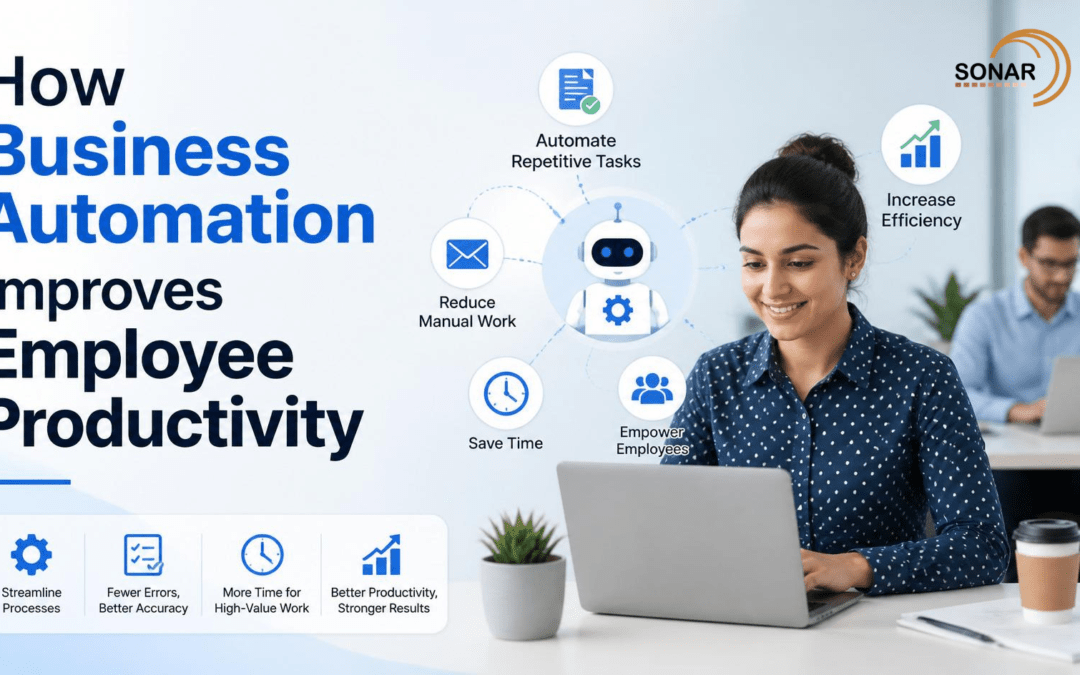
All companies desire a more productive workforce, but when it comes to productivity, asking employees to work harder isn’t enough. Increasingly, the largest barriers are poor processes, manual repetitive tasks, slow approvals, and a lack of integration between systems.
Despite this, for the most part across India, businesses are still stuck on spreadsheets and paperwork; or rely on a multitude of software applications that never quite talk to each other. It’s your last media platform premier, Employees are wasting valuable hours on administrative work instead of focusing on the activities that generate revenue, improve customer service or innovation.
This is where Business Automation Software made the difference.
Automation in Workflows: Help Employees to work smarter, automate the regular aspects of business and streamline workflows to reduce operational costs while bringing more efficiency.
In this guide, we will discuss the most common productivity challenges for organizations and how business automation offers real solutions to overcome these hurdles.
What Is Business Automation?
Business automation refers to the usage of software and technology which does an auto-execution of business processes with low human intervention involved.
Instead of manual processes, the businesses automate activities like:
- Employee attendance
- Leave management
- Shift scheduling
- Payroll processing
- Inventory updates
- Purchase approvals
- Customer communication
- Report generation
- Invoice processing
- Workflow approvals
- Asset tracking
- Task management
The goal isn’t to replace workers, but to rid them of mundane tasks to now perform more value-added duties.
Why Employee Productivity Suffers
A lot of organizations presume that underperformance is related to employee productivity. But, in all actuality, the largest reason for a team to have difficulty performing efficiently stems from old processes.
Common challenges include:
- Repetitive manual data entry
- Slow approval processes
- Duplicate work across departments
- Poor communication
- Frequent human errors
- Limited access to business information
- Delayed reporting
- Lack of process visibility
- Inefficient workforce scheduling
These problems result in frustration, waste precious time and lower overall business productivity.
Pain Point 1: Employees Spend Too Much Time on Repetitive Tasks
The Challenge
Sitting imagine an HR executive who uploads attendance records of hundreds of employees each and every day manually.
Or maybe a warehouse employee updating stuff in Excel sheets
Or a finance executive forced to match invoices with purchase orders.
Such monotonous tasks drain hours that can be utilized for strategic work.
The Solution
It is software used to automate those boring repetitive tasks for your business;
- Capturing attendance digitally
- Updating records instantly
- Sending automated notifications
- Creating reports automatically
- Synchronizing data across departments
Employees are saving time and being able to concentrate on work which delivers genuine business value.
Pain Point 2: Too Many Human Errors
The Challenge
Manual work often results in:
- Incorrect payroll calculations
- Duplicate entries
- Inventory mismatches
- Lost paperwork
- Incorrect reports
- Missed deadlines
A small error can result in financial losses, erode customer satisfaction etc.
The Solution
Predefined workflows and validation rules automate processes and minimize manual intervention to give you more accurate and consistent business operations.
Pain Point 3: Slow Approval Processes
The Challenge
Lots of companies are still using long emails, phone calls, or paper forms to get approval.
Employees often wait days for:
- Leave approvals
- Purchase requests
- Expense claims
- Vendor payments
- Shift changes
Such delays further delays the operation, thereby impacting productivity.
The Solution
Automated approval workflows direct requests to the appropriate managers in seconds, send reminders, and maintain a complete record of approvals to minimize delays and strengthen accountability.
Pain Point 4: Lack of Real-Time Information
The Challenge
If you are a manager, you might frequently ask tough questions:
- Which employees are available today?
- What is today’s production output?
- Which inventory items are running low?
- How many customer orders are pending?
Decisions, therefore, often rely on past data because there is no live information available.
The Solution
Business automation offers centralized dashboards that produce live updates across departments for quick and informed decision-making.
Pain Point 5: Poor Communication Between Departments
The Challenge
Sales, HR and finance using one system and warehouse plus operations on a different.
As a result:
- Information gets delayed.
- Employees repeat the same work.
- Departments work in isolation.
- Customer service suffers.
The Solution
Integrated business automation software bridges functions, allowing all parties to work from the same accurate and up-to-date information.
Pain Point 6: Organizational Growth Process becomes a Pain
The Challenge
However, as you grow, it becomes increasingly complex to manage attendance, shifts, leave, payroll, and performance manually.
Administrative workload increases significantly.
The Solution
Business automation could be scaled up with your organization and deals with your approach so as to ensure that developing groups need not mean an augment in managerial endeavors.
Pain Point 7: Employees Spend More Time Searching Than Working
The Challenge
Employees spend time searching for:
- Documents
- Reports
- Customer information
- Inventory records
- Previous approvals
This may affect the efficiency, and it may delay work.
The Solution
Centralized data storage and document management allows the information to be accessed quickly thus, there is less search time and you can also collaborate well with others.
Pain Point 8: Managers Lack Visibility Into Performance
The Challenge
- Without that reporting, how do managers quantify:
- Employee productivity
- Attendance trends
- Department performance
- Project progress
- Operational efficiency
Your Decisions are Reactive Rather than Strategic.
The Solution
Real-time analytics and performance reports generated by the automation software help managers to analyze any bottlenecks in the resources optimally used.
Key Areas Where Business Automation Improves Productivity
Workforce Management
Automation helps businesses:
- Track attendance
- Manage shifts
- Process leave requests
- Monitor overtime
- Improve workforce planning
Less paperwork for employees, more productivity in the HR teams.
Inventory Management
Automation enables businesses to:
- Monitor stock levels
- Generate reorder alerts
- Reduce stock shortages
- Improve warehouse accuracy
- Speed up inventory audits
They enable warehouse staff to process orders more quickly and with far lower human error.
Customer Relationship Management (CRM)
Automated CRM systems help:
- Capture leads automatically
- Schedule follow-ups
- Track customer interactions
- Generate sales reports
- Improve customer response times
The power of content curation helps sales teams focus on building relationships and selling.
Finance and Accounting
Automation simplifies:
- Invoice processing
- Payment reminders
- Expense approvals
- Financial reporting
- Budget tracking
Finance teams can focus less on repetitious calculations and paperwork.
Document Management
Digital document workflows reduce:
- Paperwork
- File searching
- Document duplication
- Manual approvals
Employees locate the required information easily and this boosts collaboration.
Benefits of Business Automation
Automation is all these things and more, but businesses that automate often see:
- Higher employee productivity
- Faster decision-making
- Reduced operational costs
- Improved employee satisfaction
- Better collaboration
- Increased accuracy
- Stronger compliance
- Faster customer service
- Better resource utilization
- Scalable business operations
And these improvements make way for sustainable growth and a better competitive edge.
Industries That Benefit the Most
You can broaden up your scopes as you attain business using automation which is valuable in many sectors like:
- Manufacturing
- Warehousing
- Logistics
- Retail
- Healthcare
- Hospitality
- Construction
- IT Services
- Education
- Financial Services
- Distribution
- Professional Services
Automation can help any organization that has repetitive workflows or increasing operational complexity.
How to Choose the Right Business Automation Software
When evaluating solutions, look for features such as:
- Workflow automation
- Workforce management
- Inventory management
- Document management
- CRM integration
- ERP compatibility
- Cloud access
- Mobile applications
- Reporting dashboards
- User-friendly interface
- Data security
- Scalability
You need your ideal platform to fit in well with all of the systems you already have and provide great support on your long-tailed goals for success.
Conclusion
Increasing employee productivity is not by working more hours but rather eliminating all the unproductive work.
Business Automation Software helps businesses minimize manual processes, improve collaboration, automate repetitive tasks, and equip employees with the right tools to work efficiently.
With you in control of a manufacturing plant, warehouse, retail chain, logistics business, or corporate office, automation leads to a more productive workspace while cutting operating costs and maintaining growth capacity.
In the background of more Indian businesses opening themselves to digital transformation, investing in business automation is not merely a technology upgrade but also strategic advancement in the pursuit of efficiency, employee satisfaction and long-term survival.
Frequently Asked Questions
1. What is business automation?
Business automation uses software to automate repetitive tasks and workflows, reducing manual effort and improving operational efficiency.
2. How does business automation improve employee productivity?
It eliminates repetitive work, reduces errors, speeds up approvals, improves access to information, and allows employees to focus on higher-value tasks.
3. Which businesses should invest in business automation?
Manufacturing, logistics, retail, warehousing, healthcare, professional services, and any business looking to streamline operations and improve productivity.
4. Can business automation integrate with ERP and CRM systems?
Yes. Most modern business automation platforms integrate with ERP, CRM, HRMS, accounting, and inventory management systems.
5. What are the biggest benefits of business automation?
Key benefits include improved productivity, reduced operational costs, fewer errors, faster workflows, better collaboration, real-time reporting, and enhanced scalability.